

Products


Halogen-free flame retardant
During decomposition, absorb the heat, smoke, harmful gases generated by combustion, and adsorb melted residues to slow down or terminate combustion
Product Overview
DESCRIPTION
1. Composite material composed of eutectic ultrafine powder mainly composed of magnesium and aluminum hydrates, surface modified by molecular layer
2. It is an emerging non red phosphorus environmentally friendly filling flame retardant that does not produce harmful substances when the substrate burns
3. During decomposition, absorb the heat, smoke, harmful gases generated by combustion, and adsorb melted residues to slow down or terminate combustion
4. There are multiple models to choose from, and the flame retardancy reaches UL94-V0 or VW-1 level when meeting the recommended dosage
Product Application
1. Halogen free flame retardants are non-volatile, non migratory, and have long-lasting effects in the substrate
2. Good dispersibility, large filling amount, good processability, and stable physical and chemical properties of the final product
3. Suitable for epoxy resin, acrylic resin EVA、PA、PBT、PET、PE、PVC、PU、 Processing substrates such as silicone rubber and polyolefin rubber into products with high solid content, high dispersibility, and high fluidity
oduct specifications
Aluminum series
Whiteness | Average particle size | 105℃ Volatile component | active ingredient |
≥96% | 1μm~17μm | ≤0.5% | ≥98% |
Magnesium series
Whiteness | Average particle size | 105℃ Volatile component | active ingredient | |
Physical magnesium | ≥90% | 3μm~20μm | ≤1.0% | ≥90% |
Chemical magnesium | ≥98% | 1μm~6μm | ≤0.8% | ≥98% |
Special customization technology
1. Double layer surface treatment
The material after surface modification treatment has the following characteristics:
(1) Reduce reunion
(2) Reduce resin viscosity
(3) Improve compatibility with resin to enhance product performance
Examples of commonly used surface treatment agents
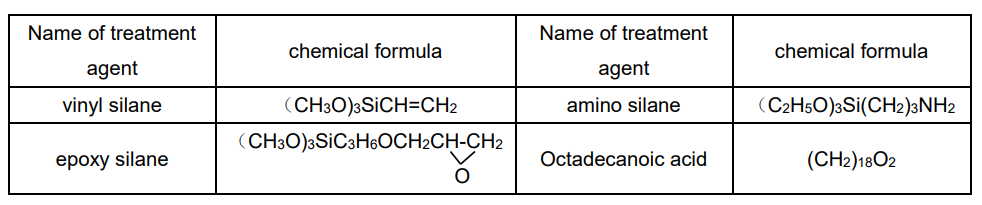
In addition to the above treatment agents, other treatment agents can also be used according to customer needs
1. Particle size compounding treatment
The material after particle size compounding treatment has the following characteristics
(1) Increase the filling amount
(2) Reduce resin viscosity
2. Decentralized technology
After dispersion treatment during the processing, the material has the following characteristics
(1) Reduce reunion
(2) Good processability
We can produce powder products, slurry products, and masterbatch products according to customer requirements
Cases
1.Organosilicon
a.
Reference formula (room temperature curing)
Component | Brand | Number of copies |
Resin | 107 | 100 |
Plasticizer | Silicone oil | 10~30 |
Flame retardant powder | JLH-A1D7 | 130 |
Collaborative flame retardant | Melamine phosphate | 40 |
Gas silicon | H18 | 5 |
| UV absorbent | Tinuvin 326 | 4 |
light stabilizer | Tinuvin 770 | 4 |
Crosslinking agent | Silane coupling agent | 1~3 |
catalyst | Organic tin or organic titanium | 1~2 |
b.Performance testing
Test project | Unit | Experimental data |
Droop | min | ≤3 |
Surface drying time | min | 30 |
Extrudability | mL/min | 90 |
Shear strength | Mpa | 1.7 |
Breaking strength | Mpa | 1.5 |
Elongation at break | % | 300 |
Flame retardant grade | HB | Qualified |
Test environment: 23 ℃. 50% RH. The above data is laboratory reference data
2.Product Application Cases
a. Reference formula (curing conditions: 30 minutes/100 ℃)
Component | Brand | Number of copies |
Resin | Bisphenol F epoxy resin | 50 |
Reactive diluent | E10P | 20 |
Flame retardant powder | JLH-A1D7 | 120 |
Synergist | 25 | |
Latent curing agent | Adeka EH-5031S | 50 |
stabilizer | Huntsman Arocy B10 | 10 |
UV absorbent | Tinuvin 326 | 1 |
Test environment: 23 ℃, 50% RH, curing. The above data are laboratory reference data
b.Performance testing
Test project | Unit | Experimental data |
Cure temperature | ℃ | 130 |
Curing Time | min | 15 |
Hardness | 邵氏D | 80 |
Tensile modulus | MPa | 200 |
| Tensile strength | N/mm2 | 25 |
Elongation | % | 3 |
Halide Content | ppm | 900 |
Flame retardant grade | A2 | qualified |
Test environment: 23 ℃, 50% RH, curing. The above data are laboratory reference data
3.copper clad laminate
Comparison of the effect with corresponding foreign brands when adding 43%
Test project | Unit | X04IO | X04LEO | A1D9 | ||||||
| TG | ℃ | 125.0/126.1 | 124.0/125.9 | 126.5/127.6 | ||||||
| TD | ℃ | 315.2 | 314.7 | 314.4 | ||||||
| T288 | min | 1.07 | 0.50 | 1.29 | ||||||
| CTE | ppm/% | α1 | α2 | Z轴 | α1 | α2 | Z轴 | α1 | α | Z轴 |
| 40.38 | 274.7 | 4.20% | 47.83 | 333.1 | 5.07% | 31.12 | 288.7 | 4.25% | ||
Floating welding | sec | 100 | 108 | 126 | ||||||
dip Soldering | sec | 80 | 86 | 90 | ||||||
Thermal shock | 次 | 4 (288℃/10Sec) | 4 (288℃/10Sec) | 6 (288℃/10Sec) | ||||||
Peel strength | N/mm | 1.57 1.58 | 1.62 1.58 | 1.63 1.58 | ||||||
Flame retardant | sec | V0(max:2.3 sum:5.8) | V0(max:2.2 sum:6.3) | V0(max:2.8 sum:6.6) | ||||||
Application of Modified Aluminum Hydroxide on Organosilicon
Type of base material | Methyl vinyl silicone gel | ||||||
Test brand | A1D4 | A1D9 | A1D10 | A1D12 | A5D15 | A5D7 | A1D7 |
Addition amount% | 40 | 40 | 40 | 40 | 40 | 50 | 40 |
tensile strength Mpa | 4.1 | 4.4 | 3.8 | 5.2 | 4.9 | 6.5 | 4.9 |
Tear strength | 14.4 | 15.1 | 13.8 | 16.5 | 15.6 | 17.3 | 25.1 |
Elongation at break % | 275 | 306 | 252 | 335 | 233 | 201 | 523.2 |
Proportion | 1.45 | 1.45 | 1.45 | 1.45 | 1.45 | 1.45 | 1.45 |
Hardness | 62 | 62 | 62 | 62 | 62 | 68 | 62 |
Flame retardant grade | V1 | V1 | V1 | V1 | V1 | V0 | V1 |
Back
